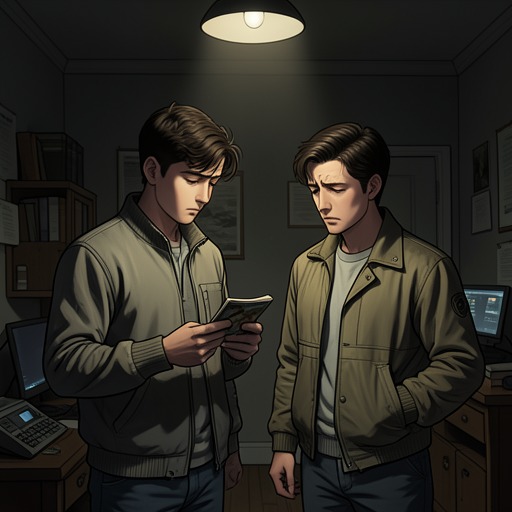
Cameron finds a possible clue to his biological father and travels to Washington
Remarkably Bright CreaturesCameron Cassmore’s discovery of a class ring and photograph gives his uncertain search for a father its first concrete lead: a name, Simon Brinks, and a plausible connection to his mother’s past. The evidence is suggestive rather than conclusive, but it changes the scale of Cameron’s hope. What begins as a rummage through unwanted possessions becomes an immediate plan to travel to Washington and confront the possibility that an unknown man could be his biological father.
The Box and Its Hidden Clue
Among the odds and ends in a box from his aunt, Cameron finds jewelry in a small black drawstring bag: four bracelets, seven necklaces, two empty lockets, and a broken silver chain. He is assessing the pieces for their possible pawn value, not looking for family history. When he shakes the bag to make sure it is empty, a folded photograph wrapped around a heavy class ring finally comes loose. The ring identifies its class as the 1989 graduating class of Sowell Bay High School, while the photograph shows a smiling teenage version of his mother with a young man Cameron does not recognize.
The arrangement of the objects matters to the discovery. The photograph is folded around the ring and concealed in the bottom of the bag; neither item is presented to Cameron as an explanation of his parentage. He encounters them while sorting possessions primarily for cash, and only after the ring’s inscription and the pictured embrace attract his attention does a discarded bundle become a possible record of his mother’s past. The physical clue supplies what Cameron has lacked: not proof, but an image he can compare against other traces.
From a Yearbook to a Name
Cameron searches online for the 1989 class and finds that the reunion group has made an extensive collection of material available, including what appears to be the entire senior yearbook. He looks through the scanned photographs for his mother and, more particularly, for the man beside her in the old picture. The ring’s faint underside engraving, EELS, initially confuses him: he takes it for the school mascot, an assumption that gives him another detail to test against the yearbook.
A photograph of his mother on a crowded pier supplies the decisive identification. The same young man has his arm around her, his face turned into her windblown hair. The caption names them as Daphne Cassmore and Simon Brinks. Cameron recognizes the man from the photograph found with the ring and moves at once from an anonymous boyfriend to a named possible father. He confirms the name through an online search, whose results describe Brinks as a prominent Seattle real estate developer and nightclub owner, with coverage of his vacation home and Ferrari. The search establishes Brinks’s public identity and apparent wealth; it does not establish paternity.
A Possibility, Not a Confirmation
The photograph also prompts Cameron to reconsider when it was taken. He studies its background, where flowers are blooming, and estimates that it may date to April, though March or May remain possible. Since he was born on February 2, he works backward from his birth and concludes that the timing could fit. The calculation strengthens the possibility that Brinks is his father, but its uncertainty remains essential: the photograph is not a birth record, and the match in timing cannot by itself verify a biological relationship.
Cameron’s response to the image is not only investigative. He compares his mother’s appearance in the photograph with the Daphne he remembers: here she looks healthy and carefree, with a broad smile and plump cheeks; in his memories she is bony and sunken. The picture therefore offers him a glimpse of a version of his mother he has not known, as well as a possible answer about his own origins. Its evidence is intimate but incomplete. It shows a relationship between Daphne and Brinks, and its date may fit Cameron’s conception, yet the meaning of that relationship remains unresolved.
The Decision to Go
When Cameron considers what to do with the lead, he raises the possibility that belief in Brinks as his father might matter more to him than confirmation. Elizabeth challenges the idea of approaching a stranger merely because he appears in a photograph with Cameron’s mother, and points toward the difference between claiming a father and finding out whether a relationship might actually be possible. Cameron does not settle that tension. He says he will go to Washington and find Brinks, while recognizing the practical obstacle: he has no obvious way to make the long trip.
That intention becomes action during the last night of Cameron’s stay in California. Awake in the early hours and using his phone, he books a JoyJet flight to Seattle departing Sacramento International at five in the morning, only three hours away. He hurriedly packs his clothes, including every pair of boxers he owns, and the jewelry bag. The departure is precarious even on its own terms: he has to trust that his credit card transaction will clear, and the evidence shows him booking and preparing to leave rather than confirming what happens after arrival.
Cameron’s resolve carries two motives that pull in different directions. The prospect of a father offers the chance of connection, but Cameron also imagines Brinks paying for the fatherhood he believes he missed over the past thirty years. His fantasy of compensation sits beside a more uncertain desire to know who Brinks is and whether they could have a relationship. The trip begins before either question has an answer. A class ring, a photograph, a caption, and an online search have converted an old absence into a live possibility—and made Cameron willing to cross the country to test it.